








Heavy Duty FFS Film, Tubular Sack Film, and Why PLASTAR Is Your Ultimate Blown Film Machinery Partner
Industrial packaging lines demand materials that can take a beating. From 25 kg bags of polymer pellets to hazardous chemical powders and damp fertilizers, the market has shifted decisively toward Heavy Duty FFS (Form-Fill-Seal) Film and Heavy Duty Tubular Sack Film.
For packaging film manufacturers, producing these high-spec films is a massive business opportunity—but it is also a technical challenge. Achieving uniform wall thickness, high drop-impact strength, and flawless gusset symmetry at high output rates requires specialized extrusion technology.
Below is an overview of why these films dominate bulk packaging, the manufacturing hurdles involved, and how PLASTAR's advanced blown film machines and turnkey engineering support provide the complete solution for your production floor.
1. Understanding the Market: Heavy Duty FFS & Tubular Sack Films
Automated Line Flow: [Continuous Gusseted Roll] -> [Automated Packaging Machine] -> [Cut & Bottom Seal] -> [Rapid Dosing] -> [Top Hermetic Seal] -> [Stable Pallet Stack]
What is Heavy Duty FFS Film?
Form-Fill-Seal (FFS) Film is supplied as a continuous roll of flat or tubular plastic that runs through fully automated packaging lines. In one continuous, high-speed sequence, the machine forms the bag, fills it with a pre-weighed dose (typically 10 kg to 50 kg), and hermetically heat-seals the top. It delivers packaging speeds up to 2,000 bags per hour while cutting labor and unit packaging costs compared to pre-made bags.
What is Heavy Duty Tubular Sack Film (Tubular Bag Film)?
Tubular sack film (or tubular bag film) is extruded directly as a seamless, continuous cylinder with factory-set side gussets:
- Seamless Structural Body: Because the tube is blown in one piece, the finished sack has no longitudinal side seams, eliminating the most common point of failure under dynamic drop impacts.
- Streamlined Converting: Packing machines only need to cross-cut and weld the top and bottom seals, accelerating cycle times and reducing mechanical wear.
Why Are These Films Vital for Fine Chemicals & Bulk Goods?
- Zero Sifting & Contamination: Fine chemical powders (< 50 µm) easily seep through stitched or sewn paper seams. Seamless tubular film ensures a completely leak-free container body.
- Hermetic Moisture & Vapor Barrier: Multi-layer polyethylene protects hygroscopic chemicals, fertilizers, and minerals from absorbing atmospheric moisture and hardening.
- Worker & Plant Safety: Automated FFS lines working with tubular film keep hazardous, toxic, or irritating powders fully enclosed during bagging.
- Chemical Resistance: Pure virgin PE contact layers do not react with acids, alkalis, or oxidizing compounds.
Technical Performance Benchmarks
| Technical Parameter | Heavy Duty FFS Film | Heavy Duty Tubular Sack Film |
|---|---|---|
| Film Profile | Continuous flat sheet or open-mouth roll | Pre-gusseted seamless tube roll |
| Co-Extrusion Structure | 3-Layer (ABC) or 5-Layer Co-extrusion | 3-Layer (ABC) or 5-Layer Co-extrusion |
| Thickness Range | 80 to 220 µm (0.08–0.22 mm) | 90 to 220 µm (0.09–0.22 mm) |
| Lay-Flat Width | 400 mm to 800 mm | 350 mm to 650 mm (Gusset: 40–120 mm) |
| Dart Drop Impact | ≥ 800 g (ASTM D1709) | ≥ 800–1300 g (ASTM D1709) |
| Tensile Strength (MD/TD) | ≥ 28 / 26 MPa (ASTM D882) | ≥ 30 / 28 MPa (ASTM D882) |
| Surface Friction | Static COF 0.45–0.65 | Static COF 0.50–0.65 (Anti-slip, ASTM D1894) |
Key Applications Across Industries
- Petrochemicals & Polymers: 25 kg bags for PE, PP, PS, and ABS virgin resin pellets and masterbatches.
- Fine & Specialty Chemicals: Caustic soda flakes, titanium dioxide, soda ash, pigments, and battery salts.
- Agriculture & Agrochemicals: NPK fertilizers, urea prills, animal feeds, and crop seeds.
- Building & Mineral Materials: Dry-mix mortar, cement additives, silica sand, and gravel.
- Bulk Food Ingredients: Industrial sugar, coarse salt, raw grains, and starches.
2. The Production Reality: Critical Pain Points in Heavy-Duty Film Extrusion
Extruding heavy-gauge films (120 µm to 220 µm) with high metallocene polyethylene (mPE) content creates four distinct processing challenges:
- 1. Gauge (Thickness) Deviations & Roll Defects: Thick films generate high melt pressure and uneven cooling. A minor temperature variance creates thick/thin bands across the web, causing loose roll edges, web sag, and printing misregistration (ISO 4593).
- 2. Gusset Asymmetry & Bubble Snaking: Tubular sack film requires identical gusset depths on both sides. Bubble instability or lateral drift (> 2 mm) skews the bag geometry, causing feed jams on automated packaging lines (TAPPI Blown Film Guide).
- 3. Seal Failures from Powder Contamination: In chemical or fertilizer bagging, airborne dust settles on the bag mouth. If the inner film layer lacks high hot-tack strength, bottom seals rupture during drop tests (ASTM D1709).
- 4. Core Heat Retention, Blocking & Static Cling: Thick tubular film wound at high speeds retains heat in the roll core. Without rapid cooling and active static neutralization, inner surfaces fuse together (blocking) or generate static charges (> 15 kV) that prevent bag opening (ASTM D3354).
3. How PLASTAR Machinery Overcomes Every Production Bottleneck
PLASTAR engineers its ABC Three-Layer and Five-Layer Co-extrusion blown film lines specifically to eliminate the physical and thermal challenges of heavy-duty FFS and tubular sack film production.
Pain Point 1: Melt Flow Inconsistency & Heavy Screw Wear
The Problem: Blending tough, high-viscosity resins like Metallocene LLDPE (mLLDPE) and HDPE at heavy gauges (120 to 220 µm) creates severe backpressure, rapid screw degradation, and uneven melt plastification.
PLASTAR Solution: PLASTAR equips all main extruders with wear-resistant dual-alloy forced-feeding screws (30:1 L/D) and water-cooled barrel feeding sections. This alloy construction delivers 3 to 5 times the service life of conventional screws while maintaining uniform melt homogenization under high-speed, high-pressure continuous operation.
Pain Point 2: Gauge (Thickness) Deviations & Die Channel Degradation
The Problem: Polymer stagnation in internal die runners leads to resin burning, gauge bands across the bubble, and lengthy downtime during resin changeovers.
PLASTAR Solution: PLASTAR utilizes 3D thermofluidic-simulated cone stacking (3-layer) and plane stacking (5-layer) die heads. Highly polished, precision-coated internal runners create a self-cleaning scouring effect under high-pressure extrusion, preventing carbon build-up and minimizing scrap during formula switches. In addition, an automatic thickness control system and rotating upper traction structure redistribute and eliminate gauge bands for perfectly flat film rolls.
Pain Point 3: Bubble Sagging, Heat Retention & Tube Sticking (Blocking)
The Problem: Thick tubular sacks retain high core heat when wound at speed, causing internal tube walls to fuse together (blocking) and generating static charges (> 15 kV).
PLASTAR Solution: Every heavy-duty PLASTAR line features a built-in Internal Bubble Cooling (IBC) system combined with a high-efficiency double-lip air ring. This cold/hot air exchange system extracts thermal energy directly from inside the bubble, accelerating film crystallization, preventing blocking, and increasing line output speeds by up to 1.33x compared to conventional machines. Integrated static neutralization bars can also be configured at the winder to eliminate static cling for smooth downstream bag opening.
Pain Point 4: Sizing Errors & Uneven Side-Gusset Folds
The Problem: High-speed tubular sack conversion requires symmetrical side-gusseting within tight tolerances (≤ ±1 mm); otherwise, automated packaging spouts jam.
PLASTAR Solution: PLASTAR integrates motorized side-gusseting assemblies directly beneath the oscillating traction unit, working in tandem with the line's centralized touchscreen control module to ensure uniform fold geometry across widths up to 2000 mm.
4. PLASTAR's Machinery Lineup for Heavy Duty Film Production
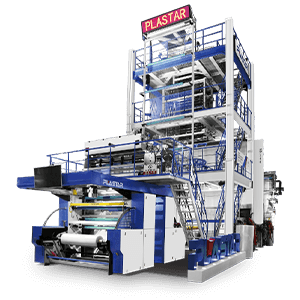
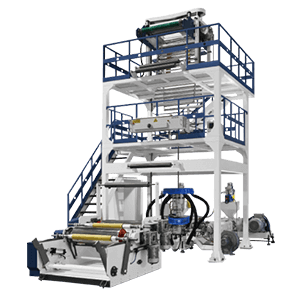
PLASTAR ABC Three-Layer Co-extrusion Blown Film Machine
The dedicated industry standard for heavy-duty FFS film, gusseted tubular bag film, and high-strength industrial sacks:
- Cone Stacking Die Technology: Features a precision 3-layer cone stacking die with integrated IBC and a double-lip air ring for rapid bubble cooling.
- Flexible Layer Engineering: Three independent extruders allow custom formulation ratios—Outer Layer (A) with anti-slip masterbatch and UV stabilizers; Core Layer (B) with heavy mLLDPE/HDPE blends for high dart-drop impact (≥ 800 g); Inner Layer (C) with low-temperature plastomers for instant hot-tack sealing through chemical powder dust.
- Key Specifications: Film Width Range: 1000 mm to 2000 mm; Film Thickness Range: 20 to 200 µm (customizable up to 220 µm for heavy-duty FFS); Maximum Extrusion Output: 180 kg/h to 350 kg/h; Suitable Resins: HDPE, LDPE, LLDPE, mLLDPE, EVA.
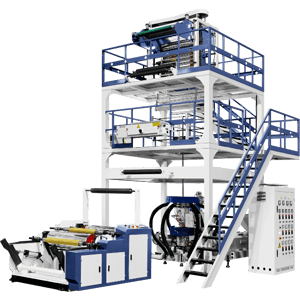
PLASTAR Five-Layer Co-extrusion Blown Film Machine
Engineered for high-barrier chemical sacks, cold-stretch hood films, and high-performance down-gauging projects:
- Advanced 5-Layer Plane Stacking Die: Streamlined runner design optimized with thermofluidic modeling for clean multi-polymer flow and minimal maintenance downtime.
- Inter-Layer Ratio Control & Down-Gauging: Enables precise layer adjustments (from 1:1:1:1:1 up to wide asymmetry such as 1:1:6:1:1), allowing producers to down-gauge film thickness by 15% to 25% without sacrificing mechanical strength.
- Barrier & Specialty Polymer Processing: Seamlessly processes combinations of HDPE, LDPE, LLDPE, EVA, and barrier polymers (EVOH/Nylon) to shield fine chemicals and volatile bulk products from oxygen and moisture.
- Key Specifications: Film Width: 1500 mm (expandable up to 3000 mm on custom models); Film Thickness Range: 30 to 200 µm (customizable up to 220 µm for heavy-duty applications); Maximum Extrusion Output: Up to 300 kg/h; Extruder Configuration: 55 mm × 4 + 60 mm × 1 (30:1 L/D water-cooled); Certifications: Swiss SGS certified and EU CE certified.
5. Turnkey Engineering & Global Service Support
PLASTAR provides comprehensive manufacturer-direct support throughout the entire equipment lifecycle:
- Centralized Smart Automation: Touchscreen PLC integration brings batch gravimetric dosing, weight control, IBC cooling, auto-thickness regulation, and automatic friction winding into a single operator interface.
- Custom Machine Tailoring: Extruder screw geometries, die diameters, tower heights, and winding configurations are customized to your plant's specific floor dimensions and target resin blends.
- On-Site Installation & Commissioning: PLASTAR engineers deploy to your factory to supervise machine assembly, calibrate bubble stability, optimize formula processing parameters, and train local staff on daily operation and preventative maintenance.
- Global Compliance & Spare Parts Availability: Backed by EU CE and Swiss SGS compliance, PLASTAR supplies full English operation schematics, remote diagnostic assistance, and rapid-dispatch wear parts (dual-alloy screws, barrels, die rings, and heating elements) to ensure zero unplanned downtime.
Request a Tailored Heavy-Duty Film Line Proposal
Ready to scale up your heavy-duty FFS or tubular sack production? Send us your target film thickness (µm), lay-flat width, resin blend, and daily output requirements—PLASTAR's engineering team will recommend the optimal ABC three-layer or five-layer configuration and provide a detailed quotation. For the basics of extruder types and components, see our plastic film extruder guide.