








Plastic Film Extruder: Types, Components and How to Choose
A plastic film extruder melts plastic pellets and shapes the melt into continuous thin film. As the core of every film production line, it determines output capacity, gauge uniformity, and energy efficiency. This guide explains how film extruders work, compares blown and cast film processes, breaks down key components, and provides a practical checklist to help you choose the right system.
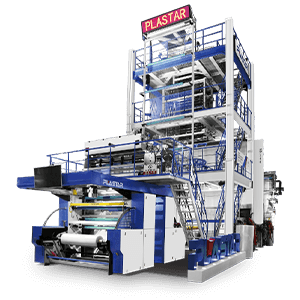
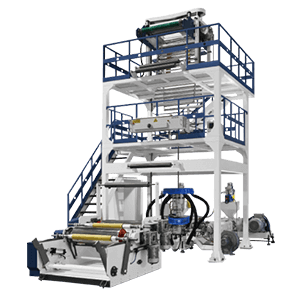
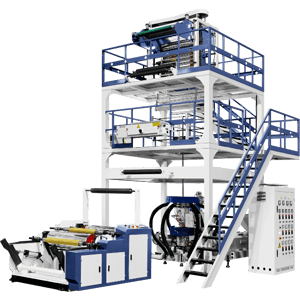
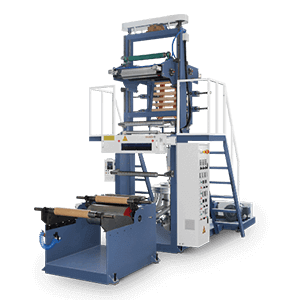
PLASTAR engineers and builds blown film extruders ranging from mono-layer lines to five-layer co-extrusion systems. You can compare our full model lineup in the specification table below.
What Is a Plastic Film Extruder?
A plastic film extruder is a machine that converts thermoplastic resin pellets into continuous film rolls. It feeds pellets into a temperature-controlled barrel, melts and homogenizes them using a rotating screw, and pushes the melt through a die head.
The molten film is then cooled, flattened through a collapsing frame, and wound onto rolls. This process produces shopping bags, food packaging film, shrink film, stretch hood film, and agricultural film.
Most film extruder machines process polyethylene resins such as LDPE, LLDPE, and HDPE. Multi-layer lines also run EVA, nylon (PA), or EVOH for sealing and barrier performance. With dedicated low-shear screw designs and precise temperature control, modern lines can also process biodegradable blends such as PBAT/PLA and modified PHA.
Blown Film vs. Cast Film Extrusion
There are two primary methods for manufacturing plastic film, differing mainly in die geometry and cooling mechanics. Choosing between them depends on your end-product strength, optical clarity, and order flexibility.
Blown Film Extruder (Tubular Extrusion)
The melt is pushed upward through an annular die and inflated by compressed air into a continuous bubble. Because the bubble stretches in both the machine direction (MD) and transverse direction (TD), blown film delivers balanced strength, high puncture resistance, and strong dart impact performance. It also forms seamless tubular film for bag making with zero edge-trim waste.
Cast Film Extruder (Flat Die Extrusion)
The melt is extruded horizontally through a flat slit die onto a chilled, polished steel roll. Rapid quenching yields high clarity, high gloss, and fast line speeds—ideal for transparent stretch wrap and lamination film—though film width is fixed by the die and requires edge trimming.
Quick Comparison
| Feature | Blown Film | Cast Film |
|---|---|---|
| Film shape | Tubular, can be slit to flat | Flat sheet |
| Film strength | Balanced in MD and TD directions | Stronger in machine direction (MD) |
| Clarity | Good (depends on resin & cooling) | Very high (rapid quenching) |
| Width flexibility | Easy to adjust via bubble size | Fixed by die width; edge trim needed |
| Typical uses | Bags, agricultural film, shrink hoods, barrier film | Stretch wrap, high-clarity packaging film |
PLASTAR specializes in blown film extruders, which cover the vast majority of bag-making, industrial packaging, agricultural, and barrier film applications. For a full process overview, read our Blown Film Machine Ultimate Guide.
Key Components of a Film Extruder System
A film extrusion line is an integrated system where every module impacts film quality, gauge tolerance, and hourly output.
- Screw and Barrel: The screw conveys, melts, mixes, and pressurizes the resin inside a multi-zone heated barrel. Screw diameter and L/D ratio (typically 28:1 to 32:1, with PLASTAR multi-layer lines commonly using a 30:1 L/D design) govern melt quality and throughput. Biodegradable resins require low-shear screw geometry to prevent thermal degradation.
- Die Head: The die head distributes the melt into a uniform thin-walled tube. Multi-layer die heads combine separate melt streams cleanly without interfacial turbulence, directly controlling thickness uniformity. See our guide on the blown film die.
- Cooling System: An air ring directs chilled air around the exterior of the bubble. Efficient cooling stabilizes the frost line and unlocks higher output. High-capacity lines add Internal Bubble Cooling (IBC) to accelerate heat transfer from inside the bubble.
- Collapsing Frame and Haul-Off: The collapsing frame flattens the bubble into a lay-flat tube while nip rollers pull the film upward at a controlled speed to maintain target blow-up ratio (BUR) and thickness.
- Winder: The winder rolls the finished film for storage, printing, or bag converting. Precision tension control ensures clean roll edges without telescoping or blocking. Read more in our blown film winder guide.
Extruder Types by Layer Architecture
The number of extruders feeding the die defines your film's functional properties and raw material cost per kilogram.
| Extruder Type | Configuration | Structure & Main Purpose |
|---|---|---|
| Single-screw mono-layer | 1 extruder, 1 die | Lowest capital cost and simplest operation; ideal for single-resin HDPE or LDPE bags. |
| AB / ABA co-extruder | 2 extruders feeding 1 die | ABA uses a symmetrical A-B-A layout: virgin resin on outer skins with recycled PE or CaCO₃ filler in the core to cut material cost. |
| ABC multi-layer co-extruder | 3 extruders feeding 1 die | ABC uses an asymmetric 3-resin layout (e.g., sealing + structural + print/weatherable layers) for superior strength and versatility. |
| 5-, 7- and 9-layer co-extruder | 5 to 9 extruders feeding 1 die | Combines tie layers, PA (nylon) or EVOH barrier layers, and EVA sealing layers for high-barrier food and medical packaging. |
| Twin-screw extruder | 2 intermeshing screws | Used upstream for masterbatch and high-filler compounding; not the standard choice for blown film extrusion. |
Applications of Film Extruder Machines
| Industry | Typical Films | Common Materials | Recommended PLASTAR Machine |
|---|---|---|---|
| Food & beverage packaging | Vacuum pouches, milk bags, frozen food liners, lamination film | LLDPE, LDPE, EVA, nylon (barrier) | Five-Layer (barrier), ABC Three-Layer (non-barrier) |
| Industrial & heavy-duty | Heavy-duty sacks, pallet shrink hoods, blown stretch hoods | LLDPE, LDPE, HDPE, EVA | ABC Three-Layer |
| Retail & logistics | Carrier bags, courier mailers, garbage bags, eco-bags | HDPE, LDPE, LLDPE, recycled PE, PBAT/PLA | ABA Three-Layer, AB Two-Layer, Mono-Layer |
| Agriculture & construction | Greenhouse film, mulch film, silage wrap, pond liners | LDPE, LLDPE, EVA, HDPE (with UV) | Wide-width ABC Three-Layer or Five-Layer |
| Medical packaging | Sterile pouches, infusion bag film | Clean-grade LDPE, LLDPE, EVA, nylon | Five-Layer, ABC Three-Layer |
| Small-batch & lab trials | Small bags, R&D trial film | HDPE, LDPE, LLDPE, bio-resins | Mini Blown Film Machine |
- Food and Beverage Packaging: Used for meat and cheese vacuum pouches, milk bags, frozen liners, and lamination film. Choose the Five-Layer Co-extrusion line for oxygen/moisture barrier films, or the ABC Three-Layer line for non-barrier dairy and frozen packaging.
- Industrial and Heavy-Duty Packaging: Used for resin, fertilizer, and cement sacks, pallet shrink hoods, and heavy-duty blown stretch film. The ABC Three-Layer line produces tough, multi-functional asymmetric films tailored for puncture resistance and controlled shrink.
- Retail and Logistics: Used for carrier bags, courier mailers, and garbage bags. When running recycled content or CaCO₃ filler, an ABA Three-Layer line typically pays back faster than a mono-layer line by cutting resin cost.
- Agriculture and Construction: Used for greenhouse covers, mulch film, silage wrap, and pond liners. Wide-width ABC three-layer or five-layer lines let you dose UV stabilizers strictly in the outer skins, reducing additive cost. See our agricultural film machine guide.
- Medical Packaging: Used for sterile pouches and infusion bag film. Five-layer and ABC lines configured with precision dies and clean-winding modules deliver the odorless, uniform film required for medical compliance.
How to Choose a Film Extruder Machine (B2B Checklist)
Review these seven specifications before requesting a formal quotation:
- 1. Film type & thickness range: Define whether you produce shopping bags, heavy-duty sacks, shrink hoods, or barrier film, along with your target micron (µm) range.
- 2. Resins & formulation: List your base polymers (HDPE, LDPE, LLDPE, EVA, PA) and any recycled PE, CaCO₃, or biodegradable blends (PBAT/PLA/PHA).
- 3. Maximum lay-flat width: Determine your widest folded film requirement so the die diameter and blow-up ratio (typically 1.8–3.0) are properly matched.
- 4. Hourly output target (kg/h): Align screw size and cooling capacity with your daily production quota without over-sizing power consumption.
- 5. Layer architecture vs. ROI: Mono-layer offers the lowest entry cost; ABA three-layer accelerates ROI when using recycled core material; five-layer is essential for barrier food packaging.
- 6. Energy use & factory footprint: Compare installed kW, actual running power, tower height clearance, and chilled water/compressed air requirements.
- 7. Lead time, warranty & support: Verify manufacturing lead time, warranty coverage, spare parts availability, and remote or on-site commissioning.
PLASTAR Film Extruder Machine Models
| Machine Series | Model Range | Layers | Screw Diameter | Film Width | Max. Output | Materials |
|---|---|---|---|---|---|---|
| Mini Blown Film Machine | MSD-45 | 1 | 45 mm | 500 mm | 45 kg/h | HDPE / LDPE / LLDPE |
| Mono-Layer Blown Film Machine | SD-55 to SD-80 | 1 | 55–80 mm | 800–1500 mm | 55–130 kg/h | HDPE / LDPE / LLDPE |
| AB Two-Layer Co-extrusion | SG-2L800 to SG-2L1500 | 2 | 45–65 mm | 800–1500 mm | 80–160 kg/h | LDPE / LLDPE |
| ABA Three-Layer Co-extrusion | SD-2LABA800 to SD-2LABA1500 | 3 (ABA) | 55–75 mm | 800–1500 mm | 100–200 kg/h | HDPE / LDPE |
| ABC Three-Layer Co-extrusion | SGII-3L1000 to SGII-3L2000 | 3 (ABC) | 50–75 mm | 1000–2000 mm | 180–350 kg/h | HDPE / LDPE / LLDPE / EVA |
| Five-Layer Co-extrusion | SJ-5L1500 | 5 | 55 mm × 4, 60 mm × 1 | 1500 mm | 300 kg/h | HDPE / LDPE / LLDPE / EVA / Nylon |
Actual output depends on resin melt index, film gauge, and die configuration. Contact PLASTAR for an exact line proposal or browse our blown film machine catalog.
Frequently Asked Questions
- What materials can a plastic film extruder process? Most lines run LDPE, LLDPE, and HDPE. PLASTAR systems also process EVA, while five-layer lines handle nylon (PA) for barrier film. Custom low-shear screws are available for PBAT/PLA and PHA biodegradable blends.
- What is the typical output of a film extruder machine? Output scales with screw diameter and layer count, ranging from 45 kg/h on the PLASTAR MSD-45 mini line up to 350 kg/h on our largest ABC three-layer line.
- What is the difference between a blown film extruder and a cast film extruder? Blown film extruders inflate a vertical bubble for balanced MD/TD strength and flexible width control; cast film extruders quench flat melt onto chilled rolls for maximum clarity and gloss.
- How should I choose between mono-layer, ABA, and ABC three-layer? Choose mono-layer for standard bags, ABA symmetrical co-extrusion to cut costs with recycled core layers, ABC asymmetric co-extrusion for multi-functional strength, and five-layer for barrier food or medical packaging.
- How long does delivery take, and what is the warranty? PLASTAR lists a standard production lead time of 30 to 60 working days backed by a one-year warranty. Confirm exact terms with your sales engineer based on custom options.
Share your target film type, width, resin formulation, and daily output requirement—PLASTAR's engineering team will recommend the optimal blown film extruder configuration and send a tailored quote within 24 hours.